
Timeline of discovery
Discovery
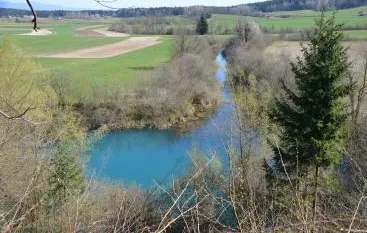
The surprising discovery of the black olm took place on 18 October 1986 during a pumping test at the Dobličica spring.
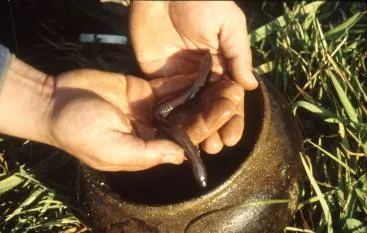
Researchers from the ZRC SAZU Institute for Karst Research and the Geological Survey observed four unknown animals in the emptied streambed and managed to capture one specimen.
For many years the Dobličica individual remained an isolated case. Only after a second specimen was found in Jelševnik in 1990 was a more precise taxonomic identification possible.
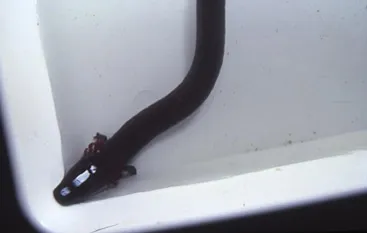
Biologists Boris Sket and Jan W. Arntzen formally described the subspecies in 1994 and assigned it the name Proteus anguinus parkelj.
Every new piece of data about the black olm is simultaneously a data point on the condition of the groundwater in the entire karst system.
Why the discovery matters
-
The species has an exceptionally restricted geographical range.
-
The subspecies provides an important model for studying evolutionary adaptations to subterranean environments.
-
The discovery strengthened the case for active protection of the underground waters of Bela Krajina.
Key milestones
- 1986
First sighting at Dobličica
On 18 October, the first specimen of the black olm is observed and captured at the Dobličica spring.
- 1990
Confirmation at Jelševnik
A second specimen is found, enabling comparison and confirmation that this is a distinct subspecies.
- 1994
Scientific description
The subspecies is formally described as Proteus anguinus parkelj.
Timeline of discovery
Discovery
How the black olm was discovered and formally described as Proteus anguinus parkelj.
Plan a visit to the info centre